

An LLC (Limited Liability Company) is a business structure created under the laws of a U.S. state that lets you operate a business and, in general, separate the company's obligations from its owners' personal assets.
LLCs are especially popular among entrepreneurs, freelancers and small businesses because of their flexibility in organizing ownership, management and tax treatment.
But what exactly is an LLC and how does it work? In this guide we explain how it is structured, who can create one, how it is taxed, how much it costs to maintain and what you need to do after forming it, whether you live in the United States or operate from another country.
Let's start with the basics!
What is an LLC?
An LLC is a business entity created under the laws of a U.S. state. In Spanish it is usually translated as sociedad de responsabilidad limitada.
Its main feature is that, generally speaking, the owners of the LLC, known as members, are not personally liable for the company's debts and obligations. The LLC is an entity separate from its owners.
For example, if an LLC takes on a business debt, its members' personal assets are normally not liable for that obligation. However, this protection is not absolute and can be affected by certain circumstances, such as personal guarantees or the company's failure to meet its legal obligations.
An LLC can have a single member or several members, and its owners can be individuals or certain entities. How it is managed and how profits are distributed can be set out in the Operating Agreement.
How does an LLC work?
An LLC operates as an entity separate from its owners that can enter into contracts, generate income, take on obligations and carry out business activities. Its members decide how the company is managed and how its profits are distributed, in accordance with state rules and, where applicable, its Operating Agreement.
In practical terms, an LLC works based on these elements:
Owners or members
The owners of an LLC are called members. An LLC can have a single member or several.
Members hold an ownership interest in the company, but an LLC does not issue shares like a corporation. How ownership interests and profit distributions are determined can be set out in the Operating Agreement.
Company management
An LLC can be managed directly by its members (member-managed) or delegate management to one or more managers (manager-managed), depending on the chosen structure and applicable rules.
This makes it possible to adapt the company's management to its needs without necessarily adopting the formal structure of a corporation.
Operating Agreement
The Operating Agreement is the agreement that sets out the LLC's internal rules.
Among other things, it can define:
Who the members are and what interest each one holds.
How decisions are made.
How profits are distributed.
What responsibilities each member or manager has.
How an interest can be transferred.
What happens if a member leaves the company.
How the LLC is dissolved.
Although its requirements vary by state, having this document helps make the company's operating rules clear.
Separation between the company and its owners
One of the fundamental features of an LLC is the separation between the company and its members.
That's why it's important to keep personal and business finances separate, use the company's accounts for its operations and properly keep the business's records.
Voting system
The owners of an LLC have voting rights based on the ownership interest they hold in the LLC. For example, if one member owns 25% of the LLC and another owns 50%, the vote of the member with a 50% interest will count twice as much as that of the member with 25%.
If voting rights have not been set otherwise in the operating agreement, the LLC must follow the voting rules established by the state in which the LLC is formed.

How is an LLC taxed?
An LLC is a legal structure, not a single tax regime. For federal income tax purposes, the IRS may classify an LLC in different ways depending on the number of members and the tax elections made.
By default:
Single-member LLC: It is generally treated as a disregarded entity, so its activities are reflected on its owner's federal tax return, unless the LLC elects to be taxed as a corporation.
Multi-member LLC: It is classified as a partnership for federal income tax purposes, unless it elects a different tax treatment.
LLC that elects corporate taxation: It can request a different tax classification through the procedures established by the IRS.
That's why it's not accurate to say that an LLC simply "doesn't pay taxes". Tax obligations depend on factors such as the tax classification, the company's activity, its income, the state where it operates and its owners' situation.
What if the LLC owner lives outside the United States?
For non-resident entrepreneurs, the situation may include additional tax and information reporting obligations.
For example, certain U.S. single-member LLCs owned by a foreign person and classified as disregarded entities may be subject to specific reporting requirements.
That's why having an LLC in the United States doesn't automatically mean being free of tax or information reporting obligations.
What are the advantages of a U.S. LLC?
Registering an LLC in the United States is a very common choice for freelancers, startups, tech companies (SaaS, apps, agencies, e-commerce) and small and medium-sized businesses, both inside and outside the United States. This is due to the many benefits of LLCs compared to other existing business structures.
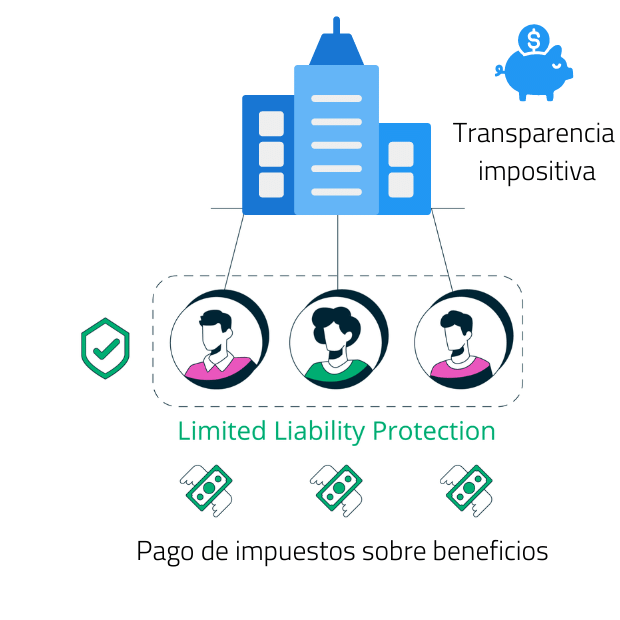
Liability protection
An LLC can help separate the owners' personal assets from business obligations. In general, members are not personally liable for the LLC's debts.
However, this protection should not be interpreted as an absolute guarantee against any obligation.
Tax transparency
Tax liability passes through to the personal tax returns of the LLC's owners, which is known as "Pass Through Taxation" or tax transparency.
As a result, some foreign LLCs owned by non-residents don't pay taxes in the United States.

Limited liability
The main advantage of an LLC is in its name: the limited liability of its members.
The owners' personal assets can be protected from the company's debts and from lawsuits against it when an owner uses an LLC to do business.
Ease of formation and management
Creating an LLC is very simple and can be done in a matter of days. It can be done online, and the cost of creating an LLC is low.
In addition, operating an LLC is very simple. It has very few formal requirements and a lot of flexibility to operate however each company prefers within the legal framework.
LLCs can have as many members as the managers agree on; members are completely free to decide how they distribute profits (by ownership, by results, by contributions...) and can draft an operating agreement to introduce any change in how it operates.
Operate in the United States and around the world
With an LLC, you can open the door to international business. You can have a bank account in the United States, and have the credibility and legal framework you need to operate in the United States as well as anywhere in the world.
It can also make it easier to manage a business that works with international clients. Depending on the activity, the provider and the applicable requirements, having a U.S. company can allow you to invoice in USD, work with certain financial service providers and use business-oriented payment platforms, such as Stripe.
For freelancers, agencies, SaaS companies, app developers and e-commerce businesses that sell outside their country of residence, having a business structure in the United States can simplify some operations and provide an internationally recognized business image.
Member privacy
In some states, the names of an LLC's members do not appear in public state records, which can offer a greater level of privacy from the public.
However, international information exchange rules have changed. CRS 2.0 (Common Reporting Standard), the update to the OECD standard, has been in force since January 1, 2026 for the jurisdictions that implement it. It applies to the 2026 tax year, and the first information exchanges are scheduled for 2027. Its new features include the addition of certain electronic money products and central bank digital currencies, as well as new rules related to crypto assets.
There's an important distinction here: the United States does not participate in the CRS. Instead, it uses mechanisms such as FATCA (Foreign Account Tax Compliance Act) and other information exchange procedures.
Therefore, the expansion of CRS 2.0 does not mean that a U.S. bank account in the name of an LLC has automatically become included in the CRS information exchange. What may be covered by the new rules are, for example, certain digital wallets and financial platforms based in jurisdictions that do apply CRS 2.0.
This doesn't mean those funds are invisible or that your tax obligations disappear. A transaction made through a wallet or platform subject to the CRS may fall within the corresponding reporting mechanisms. And, in the case of a U.S. single-member LLC owned by a foreign person, there may be information reporting obligations with the IRS, such as filing Form 5472 along with a pro forma Form 1120 when the applicable requirements are met.
So it's worth separating two concepts: the fact that an account or structure is not within a given automatic exchange mechanism doesn't mean it is anonymous. The United States has other mechanisms to provide information to foreign authorities when appropriate.
In addition, this privacy must be distinguished from BOI (Beneficial Ownership Information) obligations. Since August 14, 2026, FinCEN's final rule establishes that companies created in the United States are exempt from filing BOI information with FinCEN (Financial Crimes Enforcement Network). Certain foreign companies registered to do business in the United States may still be subject to these requirements.
In short, when we talk about an "anonymous" LLC, we mean privacy from the public state registry, not tax or financial anonymity. An LLC in the United States doesn't eliminate your reporting or filing obligations, nor does it, on its own, change your tax residence or the obligations you have in your country.
What are its disadvantages?
An LLC also has costs and obligations worth knowing before forming one.
Costs and obligations that vary by state: Each state sets its own rules, fees and requirements. New Mexico LLCs cost $50 USD, for example, while in Massachusetts it's $500, and Delaware LLCs have a $300 annual "Franchise Tax". That's why maintaining an LLC can be more expensive or complex in some states than in others.
It requires maintenance: Creating the company is just the beginning. Depending on the state and the activity, you may need to file reports, pay fees, maintain a registered agent and meet certain tax or regulatory obligations.
It may not be the ideal structure for raising venture capital: Unlike a corporation, an LLC does not issue shares. This can make it less suitable for certain businesses seeking institutional investment or structuring funding rounds.
It doesn't eliminate tax obligations: Having an LLC doesn't automatically mean paying less tax or being exempt from it. The tax treatment depends on the circumstances of the company and its owners.
It's not as easy to transfer from one party to another as a corporation's shares. Unless the operating agreement provides otherwise, some states require an LLC to be dissolved every time there is a change in ownership. This makes them less than ideal companies for attracting outside investment, for example.

Steps to register an LLC
If you're convinced that registering an LLC is a good option for you, check out our complete guide on how to create an LLC in the United States. Here we'll quickly go over the stages to follow:
Choose the state where you want to register your LLC: There are 50 states where you can register an LLC, each with its advantages and disadvantages.
Define your LLC's members: Who will own the LLC and what will their interest in the company be?
Choose your LLC's name: Your LLC's name must be unique in the state and contain the term LLC or Limited Liability Company. There are certain terms prohibited by the state.
Appoint a registered agent: A registered agent is a person over 18 years old who resides in the state where you register your LLC. They are responsible for forwarding official documents to the members. Several companies offer registered agent services.
Complete and file the "Articles of Organization": This document, downloadable from each state's website, is required to form your LLC. It contains all the key information about your business. Its cost varies by state.
Draft the Operating Agreement: This is the contract that specifies how the LLC operates. It is not mandatory.
Apply for the EIN: The EIN or Employer Identification Number is needed to open a business bank account, hire employees, etc...
Open a business bank account: A business bank account is key to separating your personal assets from the company's. It will also make accounting much easier.
Meet the annual obligations: Depending on the state, you'll have different obligations (annual reports, taxes, IRS filings). Failing to meet these obligations can lead to fines or the closure of the LLC.
How much does it cost to create and maintain an LLC?
The cost of an LLC depends mainly on the state where it is formed and the obligations it has afterwards.
When creating it, there may be costs such as:
Item | What does it depend on? |
|---|---|
Formation fee | State |
Registered Agent | Provider and state |
Operating Agreement | Drafting and the company's needs |
EIN | Applying directly with the IRS is free |
State reports | State |
State taxes or fees | State and the company's situation |
Licenses and permits | Activity and location |
The formation fee is not the only cost you should consider. Some states also require periodic reports, annual fees or other obligations to keep the company active.
The EIN, for its part, can be requested directly from the IRS free of charge.
That's why, before choosing where to form an LLC, it's worth comparing both the initial cost and the maintenance costs and obligations.
How does an LLC compare with other business structures?
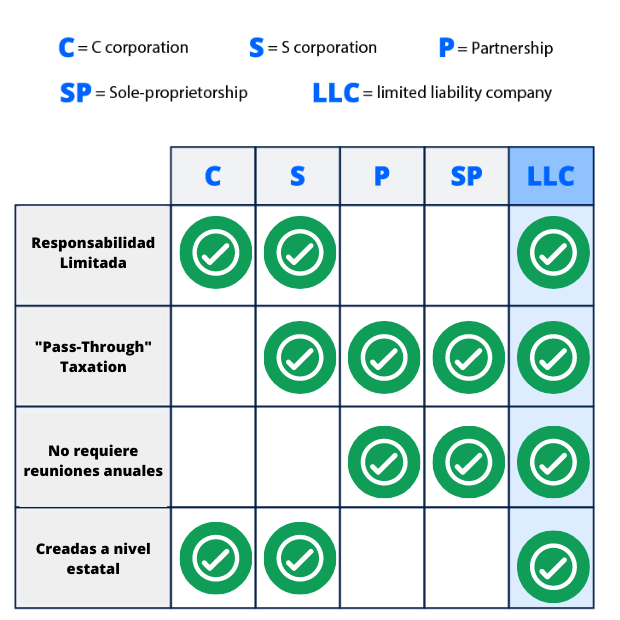
The most common alternatives to the LLC are "corporations", "partnerships" and "sole proprietorships". Let's compare them with LLCs!
LLC vs Corporations
A corporation is more formal; it involves bureaucracy, ongoing paperwork and stricter reporting than a Limited Liability Company usually requires. Instead of members, there are shareholders. That way, shares can be issued to raise funds. In addition, a board of directors must be elected to run the corporation's operations. It's also important to clarify that LLCs can elect to be taxed as corporations, without changing their legal status as an LLC.
LLC vs Partnerships
Partnerships include two or more owners who agree to share the assets, liabilities and legal burdens of a jointly owned business. Compared to LLCs, partnership-type businesses do not have limited liability and are not considered legal entities in their own right.
LLC vs Sole proprietorships
With a sole proprietorship, there is a single owner who has full control of the business. Sole proprietorships can benefit from tax transparency. Their biggest drawback is that they don't protect the owner's liability, leaving the owner solely responsible for all of the business's debts.

Can I open an LLC if I don't live in the United States?
Yes. You don't need to be a U.S. resident to own a U.S. LLC.
For an entrepreneur living in Latin America or another country, the process may involve some additional elements, such as:
Choosing the state of formation.
Having a Registered Agent.
Formally forming the LLC.
Applying for an EIN when applicable.
Preparing the business documentation.
Opening a bank or financial account compatible with the situation of the company and its owners.
Meeting the applicable tax and information reporting obligations.
However, creating an LLC from another country doesn't automatically mean you have no tax obligations in the United States. For example, certain foreign-owned U.S. LLCs may be subject to specific reporting requirements with the IRS.
You should also distinguish between having a U.S. LLC and being a U.S. tax resident: forming a company does not, by itself, make its owner a U.S. tax resident.
As you can see, an LLC can be a flexible structure for operating a business in the United States, but forming it is just the first step. Before doing so, it's worth being clear about the costs, obligations and tax treatment that apply to your situation.
If you're ready to take the next step, at Start Companies we can help you create your LLC in the United States and get it ready to start operating.
Have questions?
Can I form an LLC in the United States without being a resident?
Yes. You don't need to be a U.S. citizen or resident to form an LLC. You don't need to travel either. The process can be completed 100% online through a formation service. What you will need is a registered agent with a physical address in the state of formation, an EIN for the company and, in some cases, an ITIN for your personal tax obligations.
How long does it take to form an LLC?
It depends on the service and the state. In general, the range is 3 to 15 business days. State expedited processing fees, when available, can shorten the timeline, but at an additional cost.
Do I need a lawyer to form my LLC, or is an online service enough?
For most simple LLCs (single member, digital business, freelancer), an online formation service is enough and much cheaper than a lawyer (who can charge between $1,000 and $3,000). A lawyer becomes necessary if your LLC has multiple members with unequal contributions, operates in regulated industries, needs complex contracts or has multinational tax implications.
What's the difference between Spanish-language formation services and those that operate only in English?
Spanish-language services such as Start Companies, Firmaway or Doola are designed for non-resident entrepreneurs: they understand the tax particulars (the difference between an EIN and an ITIN, IRS obligations for foreigners), make it easier to open a bank account without being physically present and offer support in your language. English-language services such as ZenBusiness, Bizee or LegalZoom are cheaper, but they are designed for the U.S. domestic market and may not cover the needs of someone operating from Latin America.

Written by
Ignacio Navarro
Ignacio Navarro is a Certified Public Accountant, founder of Start Companies and a specialist in U.S. companies for entrepreneurs, freelancers and digital businesses in Latin America. With training in international taxation and studies at UCEMA, he advises non-resident clients on forming and maintaining LLCs, opening bank accounts, invoicing, accounting and taxes. His experience combines tax strategy, compliance and practical vision for operating in the U.S. in a simple, organized and professional way.


