
If you are evaluating how to structure your business to operate in the largest market in the world, understanding the benefits of an LLC in the United States is the first step.
An LLC (Limited Liability Company) is the most popular type of business entity in the U.S. among entrepreneurs, freelancers and digital businesses, chosen both by residents and by foreigners operating from Latin America without needing to travel, hold a visa or have residency.
In this guide you'll find the main advantages of opening an LLC, its disadvantages, a state-by-state comparison and answers to the most frequently asked questions so you can make an informed decision.
If you already know you want to move forward, you can read the guide to open your LLC as a non-resident.
What is an LLC and how does it work?
An LLC (Limited Liability Company) is a U.S. business structure that combines the asset protection of a corporation with the operational and tax simplicity of a sole proprietorship. It works as an independent legal entity: this means the company has its own legal identity, separate from that of its owners (called "members").
In practice, opening an LLC allows you to:
Operate a business legally in the United States.
Protect your personal assets from business debts.
Access bank accounts and payment platforms in U.S. dollars.
Choose how to be taxed according to your tax situation.
Give your business professional credibility.
Anyone over 18 can form an LLC, even from abroad. You don't need to be a U.S. citizen or resident, and the process is 100% remote.
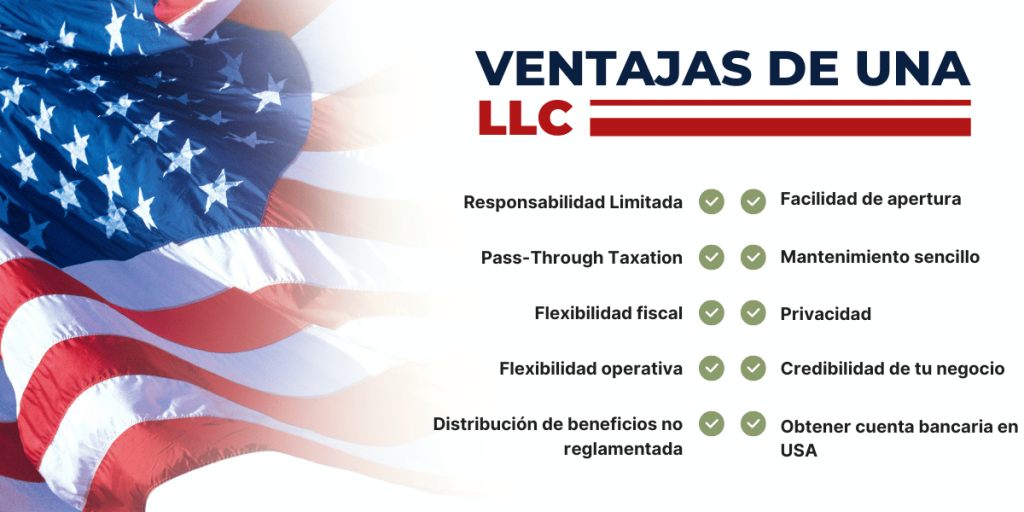
12 main benefits of an LLC in the United States
The LLC is the most balanced option for most entrepreneurs, especially foreigners, but do you know all of its benefits, both for residents and for entrepreneurs operating from abroad?
Limited liability protection
This protection is known as the "corporate veil" and it is one of the main reasons entrepreneurs choose an LLC over operating as an individual. As its name suggests, a Limited Liability Company limits the members' liability, since the company is considered an independent legal entity.
This means the individual assets of the LLC's members cannot be used to satisfy the LLC's debts and obligations. A member's risk of loss is limited to the capital they have invested in the business.
However, it's important to know that the corporate veil can be pierced in exceptional cases: if personal and business finances are mixed, if there is fraud or if the LLC is not maintained as a separate entity (for example, if a business bank account is not used). That's why it's essential to run the LLC in an orderly way from day one.
Tax advantages with pass-through taxation
One of the most attractive tax benefits of an LLC is that, by default, it operates under "pass-through taxation" (fiscal transparency). This means the LLC does not pay corporate taxes in the United States. Instead, profits "pass through" directly to the members, who report them on their personal returns.
What does this mean for non-resident foreigners?
If the LLC is owned by a non-resident foreigner ("foreign-owned"), has no physical presence in the U.S., has no employees or dependent agents in the country, and its income comes from sources outside the United States, it may qualify as not "Engaged in Trade or Business in the US" (ETBUS). In that case, the LLC may be exempt from federal taxes in the United States.
This doesn't mean no taxes are paid at all: the members must report and pay taxes in their country of tax residence according to local laws. But it does mean that, under certain conditions, there is no double taxation.
It's essential to get advice from a professional to determine the specific tax situation in each case. You can check out our tax and compliance services.
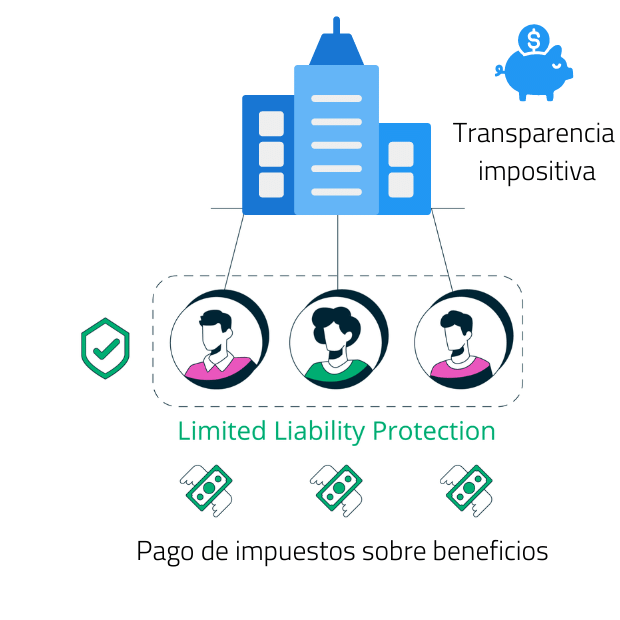
Possible federal tax exemption for foreigners
For LLCs owned by non-resident foreigners whose activity takes place entirely outside the United States (no office, no employees, no inventory in the country), there may be no obligation to pay federal income tax in the U.S.
This is because the IRS taxes income that is "effectively connected" with a trade or business within the United States. If the LLC does not have that effective connection, foreign-source income is not subject to federal taxes.
That said, the LLC still has reporting obligations. For example, single-member LLCs owned by a foreigner must file Form 5472 together with Form 1120 with the IRS every year, even if they generated no income. Failing to do so can result in penalties of $25,000 or more.
A U.S. tax exemption does not eliminate the obligation to pay taxes in the owner's country of residence. Each case should be evaluated with a tax advisor who knows both U.S. rules and those of the home country.
Flexibility to choose your tax treatment
By default, single-member LLCs are taxed as "Sole Proprietorships", and multi-member LLCs as Partnerships; that is, they work with "pass-through taxation". However, an LLC can also elect to be taxed as:
An S-Corporation: Taxation passes through, but there are no federal taxes on profits. To be taxed as an S-Corporation, the LLC must file IRS Form 2553.
A C-Corporation: The LLC is taxed directly as an independent entity. There is no direct taxation. To be taxed as a C-Corporation, the LLC must file IRS Form 8832.
To make this kind of decision, it's essential to consult a professional.
Operational flexibility and operating agreement
The way an LLC is run is very flexible, since the members determine how the LLC operates through an operating agreement, which must be signed by the members.
The operating agreement is basically a contract between the members that establishes how the company will be organized and managed internally. This includes who the members are, how new members can join, how dividends will be distributed, non-compete agreements, how the LLC can be dissolved and much more. This way, members can adapt how the business works to their needs, within the legal framework.
This flexibility makes the LLC ideal both for single-owner businesses and for multi-member partnerships with complex arrangements.
Unregulated profit distribution
By default, the LLC's profits are split according to the members' ownership percentages. However, the LLC's state default rules on profit sharing can be overridden by specifying it in the Operating Agreement.
This way, the members can freely choose the arrangement that suits them best for distributing profits.
Easy to set up (even for non-residents)
To open an LLC in the United States you do not need to:
Be a U.S. citizen or resident.
Have a U.S. visa.
Have an SSN (Social Security Number).
Already have an ITIN.
Contribute minimum capital.
Travel to the country.
All you need is a valid passport and to be over 18. If you don't have partners, you can open a single-member LLC.
The cost of opening an LLC is relatively low (the filing fee ranges from $50 to $500), and the process usually takes 2 to 3 weeks, although it can be expedited for an additional fee.
In addition, the LLC formation process can be done entirely online, and there are several companies that can take care of it for you.
State | Filing fee | Annual report | Member privacy |
|---|---|---|---|
Wyoming | $100 | $60/year | Yes |
New Mexico | $50 | Not required | Yes |
Florida | $125 | $138.75/year | No |
Delaware | $90 | $300/year | Yes |
100% remote process, no visa or travel
One of the benefits Latin American entrepreneurs value most is that the entire life cycle of an LLC is managed remotely: from formation to day-to-day operations, including opening a bank account, annual tax compliance and renewal.
You don't need to travel to the United States at any point. Formation is filed online with the relevant Secretary of State, the EIN (tax identification number) is requested from the IRS remotely, and most banks that work with non-resident LLCs let you open the business account without being physically present.
This makes the LLC especially accessible for digital entrepreneurs, freelancers and online businesses operating from any Latin American country.
Simple maintenance
Maintaining an LLC is quite simple. Your LLC's annual requirements and obligations will depend on the state where you register it, but once you've registered your LLC, you'll need to:
File an annual report (except in New Mexico, Arizona, Missouri, Ohio and South Carolina), which costs between $0 and $100 in most states.
File an annual report with the IRS
Renew your registered agent, that is, a person who resides in your LLC's state and is responsible for receiving documents and forwarding them to you.
There isn't much more to it than that! Just be careful not to forget your obligations, since that can lead to penalties or even the closure of your LLC.
You can check out our LLC renewal and registered agent services to keep your company up to date hassle-free.
Privacy
When registering an LLC, some states allow the names of the LLC's members to remain anonymous. In these states, members' names are not requested to register the LLC, nor are they published in any public document or state database. The only place their names appear is in the Operating Agreement, which is an internal document.
The states that offer anonymity are: Delaware, Nevada, New Mexico and Wyoming.
In some cases, only the name of the "organizer" is published, that is, the person who files the LLC with the state (it can be the registered agent, an attorney, the accountant or a company). The organizer must be authorized by the LLC.
It's important to clarify that having an anonymous LLC does not guarantee anonymity for its bank account or with the IRS, nor does it allow you to avoid taxes. Certain institutions can access that information.
Access to U.S. dollar bank accounts and global payment platforms
By registering an LLC in the United States and obtaining your "Employee Identification Number" (EIN), you can open a business bank account in the United States or use online payment systems such as Stripe, for example. This way, you can very easily get paid, send money or save in U.S. dollars.
Although many people think you need to go to the United States to open the bank account, that's not the case. Many banks such as Mercury, Relay, Revolut, Airwallex, etc., let you open your business bank account 100% online.
Operating in U.S. dollars is a strategic advantage that is especially relevant for entrepreneurs from countries with volatile currencies or high inflation. Holding your income in a U.S. bank account gives you exchange-rate stability and makes it easy to pay international suppliers.
In addition, using a business bank account is necessary for the LLC to maintain its corporate veil. If you mix your personal account with your business operations, you can put your personal assets at risk.

Credibility for your business
Forming an LLC to own and run your company will give your business a certain credibility with clients. When they see the legal notices on your website or receive contracts or invoices, your clients will be confident that your company is a real company. In addition, your business will have an official trade name.
Also, by having a formal legal structure in the U.S., it's easier to establish relationships with suppliers, sign international contracts and access business tools that require a legally formed entity.
Disadvantages and limitations of an LLC
No business structure is perfect. Before deciding, it's important that you also know the less favorable aspects of an LLC:
Self-employment taxes (for U.S. residents)
If you are a U.S. tax resident, the profits you receive through your LLC are subject to self-employment tax (equivalent to Social Security and Medicare contributions), which is currently around 15.3% of net income. This tax does not apply to non-resident foreigners operating from outside the U.S. with no physical presence in the country.
Regulations vary by state
Each of the 50 states has its own LLC laws: different filing fees, annual reports, state taxes and compliance requirements. This can cause confusion, especially if your LLC operates or has a presence in more than one state. That's why choosing the state of formation is an important decision. You can read the Wyoming vs New Mexico comparison to understand the differences.
Not the best option for raising investment capital
Unlike a C-Corporation, which can issue shares and has a structure that venture capital investors know and prefer, the LLC has limitations when it comes to attracting outside investment. If your plan is to raise significant funding rounds, a Corporation may be more suitable, or you can convert your LLC into a Corporation later on.
Complexity when partners exit
In a multi-member LLC, the process for a partner to withdraw can be complicated if it isn't clearly defined in the operating agreement. Unlike a corporation, where shares are simply transferred, in an LLC transferring a membership interest may require the consent of the other members.
Reporting obligations even without profits
Even if your LLC generated no income during the year, you will likely need to file informational forms with the IRS (such as Form 5472 for foreign-owned LLCs). Failing to do so can result in penalties of $25,000 or more. You can delegate this to our tax and compliance services.

Is it worth opening an LLC in the United States?
For the vast majority of Latin American entrepreneurs, freelancers and digital businesses, the benefits of an LLC in the United States far outweigh its limitations. The combination of asset protection, tax advantages, access to U.S. dollar accounts, global payment platforms and the ability to operate 100% remotely make the LLC the most practical and accessible structure for taking a business international.
That said, it isn't for everyone. If your business operates exclusively in your own country, if you're looking to raise venture capital right away, or if you have no income in foreign currency, it may not be the right time.
The best way to find out whether an LLC is the right option for your situation is to consult a specialist who understands both U.S. regulations and the reality of operating from Latin America.

Written by
Ignacio Navarro
Ignacio Navarro is a Certified Public Accountant, founder of Start Companies and a specialist in U.S. companies for entrepreneurs, freelancers and digital businesses in Latin America. With training in international taxation and studies at UCEMA, he advises non-resident clients on forming and maintaining LLCs, opening bank accounts, invoicing, accounting and taxes. His experience combines tax strategy, compliance and practical vision for operating in the U.S. in a simple, organized and professional way.