
Forming an LLC in Florida offers the benefits you are looking for to protect your personal assets, obtain potential tax advantages and maximize the credibility that the abbreviation "LLC" adds to your business name. However, like any legal business structure, Florida LLCs have their advantages and disadvantages.
In the following guide we will go over the advantages and disadvantages of forming an LLC in Florida.
Advantages of opening an LLC in Florida:
A Florida LLC combines the liability protection of a corporation with the tax treatment and administrative ease of a partnership. Florida Let's start, then, with the advantages of Florida LLCs.
Limited Liability
As its name suggests, a Limited Liability Company limits the members' liability, since the company is considered a separate legal entity.
One of the key advantages of an LLC is its limited liability structure, which protects the members' personal assets. This means that members are not personally liable for the LLC's debts and obligations, and their risk is limited to the capital they have invested in the business. This asset protection is one of the most significant advantages of setting up an LLC in Florida (although the other U.S. states offer it too).
Tax Advantages
When you open an LLC in Florida, you can benefit from very favorable tax conditions. This will depend on the nationality and country of residence of the members, whether or not there are physical establishments in the USA and whether or not there are dependent agents in the USA.
This is because LLCs enjoy what is known as " pass-through taxation". This means that the LLC does not pay taxes as a company. Instead, the LLC's owners must report on their personal tax returns the profits they have received from the LLC, and pay taxes on them in their country of residence.
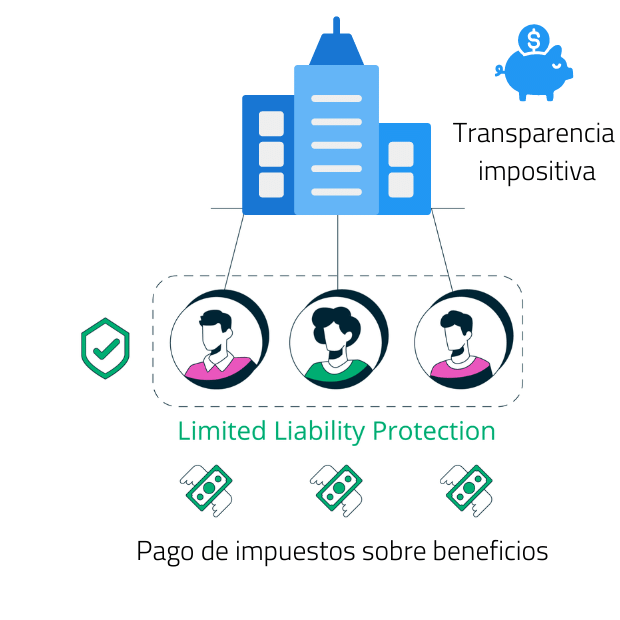
In short, the tax burden of an LLC with one or more members falls at the personal level, not at the business level.
Something important to know is that even if an LLC's profits stay in its own bank accounts, the members would have to pay personal taxes on those funds.
You can be taxed as a corporation
Continuing with taxes, a Florida LLC can choose to be taxed in different ways. This is because LLCs do not have an assigned tax regime of their own; instead, they adopt existing ones.
By default, LLCs are taxed as partnerships (if they have several members) or as a Sole Proprietorship if they have 1 member. However, LLCs can elect to be taxed as a corporation.
LLCs can therefore elect to be taxed as an S-Corp or as a C-Corp. Choosing S-Corp status can be a strategic way to reduce self-employment taxes and overall taxation once an LLC reaches a certain level of profitability. Before making this decision, consult an advisor.
Flexible company management
In general, LLCs have no restrictions on the number of members allowed. They can be single-member LLCs or multi-member.
In addition, Florida LLCs can also choose different ways of distributing profits. Unlike a standard partnership, where the split is 50-50, an LLC allows complete flexibility over how dividends will be distributed.
Finally, LLCs can be managed by the company's members, or they can appoint managers to handle the day-to-day running of the business.
The members will draft an operating agreement and in it they will agree, with a great deal of freedom, on how the LLC will operate.
No corporate formalities
One of the differences between LLCs and Corporations is that there are no formalities such as board meetings, maintaining a board of directors, or preparing annual reports. Florida LLCs are really simple to open, manage and maintain.
The only things you need to keep in mind are:
- Report your income to the IRS every year
- Pay for an annual report between January 1 and May 1, at a cost of $138.75
- Make sure you keep your registered agent up to date
Disadvantages of opening an LLC in Florida:
When considering forming an LLC in Florida, it is also important to take its disadvantages into account. The disadvantages of forming an LLC in Florida include:
Costs
The cost of registering an LLC in Florida is $125 for the filing fee. In addition, all Florida LLCs need to pay $138.75 per year for the Annual Report.
Compared with other states, such as New Mexico ($50 filing fee and no annual report), the costs of a Florida LLC can be higher.
It does not offer anonymity
There are 5 states in the USA that offer anonymity for their members, and Florida is not one of them. This means your name will be publicly associated with your LLC. The states of Delaware, Nevada, New Mexico and Wyoming do not publish members' names in public records. This gives some privacy to partners who do not want to tie their LLC to themselves personally.

Limited flexibility in ownership transfers.
Transferring ownership is usually more difficult than in a corporation. Members must establish in the LLC's operating agreement whether or not ownership transfers are allowed and, if so, whether the approval of the other members is required. If what you are looking for is the ability to easily sell pieces of your business, an LLC is not the best fit for you.
Conclusion:
Florida LLCs are a great option to take advantage of limited liability and of having a pass-through entity before the IRS, especially for non-U.S. residents.
However, we always recommend consulting an attorney or accountant to determine whether a Florida LLC is the right choice when incorporating your business. You can also check our complete guide to forming an LLC in Florida for more information on how to open one.

Written by
Ignacio Navarro
Ignacio Navarro is a Certified Public Accountant, founder of Start Companies and a specialist in U.S. companies for entrepreneurs, freelancers and digital businesses in Latin America. With training in international taxation and studies at UCEMA, he advises non-resident clients on forming and maintaining LLCs, opening bank accounts, invoicing, accounting and taxes. His experience combines tax strategy, compliance and practical vision for operating in the U.S. in a simple, organized and professional way.