

Opening a US LLC from Argentina is legal, can be done 100% remotely, and you don't need a visa, residency or to set foot in the United States. Thousands of Argentine freelancers, developers, consultants and entrepreneurs already operate with this structure to get paid in dollars, access platforms like Stripe and PayPal, and protect their personal assets.
But the process has its nuances: what obligations do you have with ARCA (formerly AFIP)? Will you pay taxes twice? Which forms do you have to file with the IRS even if your LLC had no income? How do you bring the dollars to Argentina?
In this guide you'll find everything you need to know: the requirements, the step-by-step process, the real setup and maintenance costs, the best state for your type of business, the tax obligations in both countries, and the mistakes you need to avoid from day one.
What is an LLC?
An LLC (Limited Liability Company) is a US legal structure that combines the benefits of partnerships and corporations, offering flexibility and protection for its owners. It's very popular among entrepreneurs and small businesses because of its administrative simplicity and tax advantages.
The main feature of an LLC is that it protects the personal assets of its owners, known as members. This means that, in the event of debts or legal problems, personal assets such as homes or cars are protected and can't be used to cover the company's obligations.
In addition, an LLC lets you choose how it will be taxed:
As a separate entity.
Through the members' personal income.
This makes it a structure that offers greater flexibility to adapt to the needs of the business.
But these are the benefits of an LLC in general, so it's also worth knowing the specific advantages for Argentine entrepreneurs:
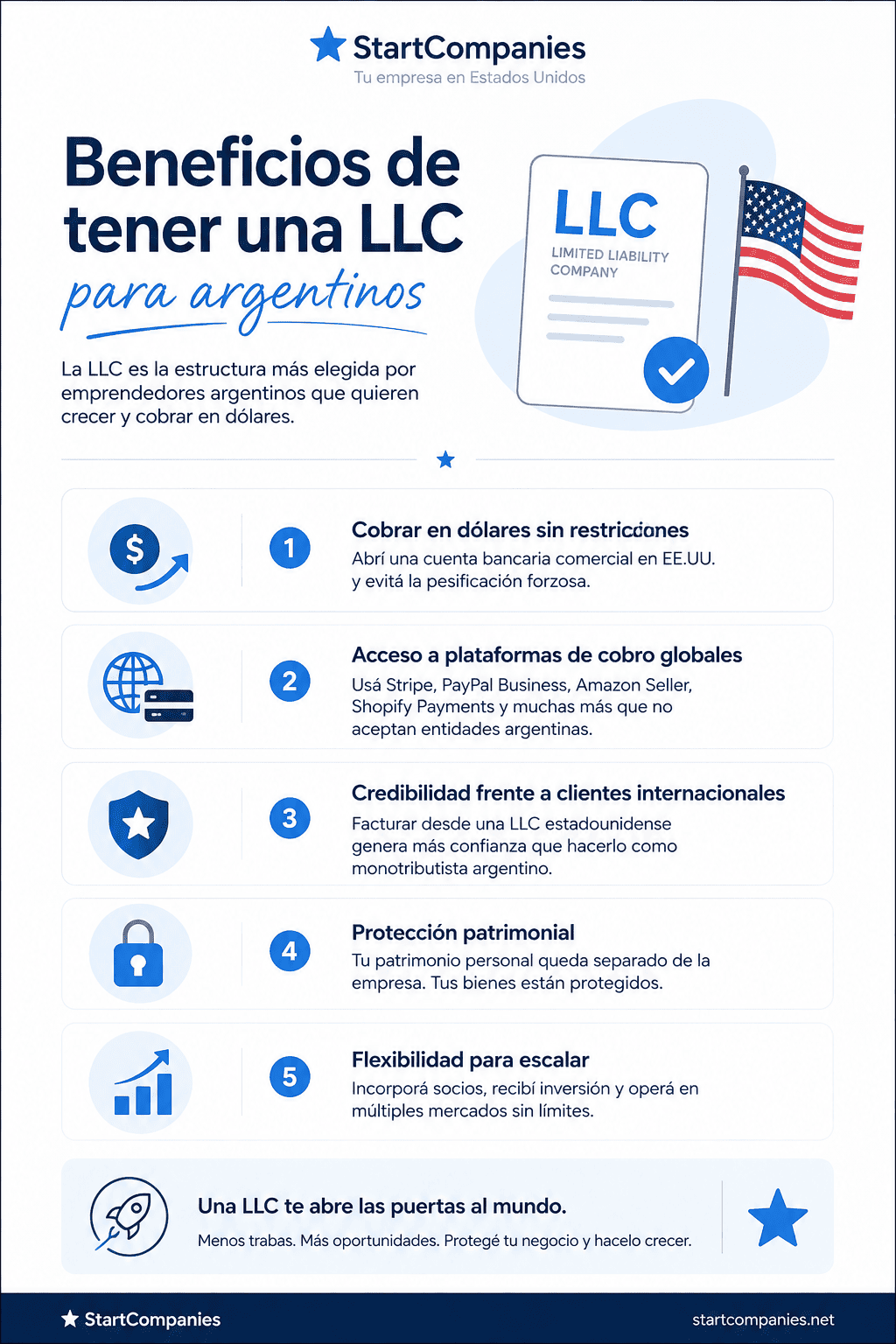
Get paid in dollars without currency controls: open a US business bank account and avoid forced conversion to pesos.
Access to global payment platforms: Stripe, PayPal Business, Amazon Seller, Shopify Payments; many of these don't accept Argentine entities.
Credibility with international clients: invoicing from a US LLC builds more trust than doing so as an Argentine monotributista (simplified-regime taxpayer).
Asset protection: personal assets are kept separate from the company.
Flexibility to scale: bring in partners, receive investment, operate in multiple markets.
Requirements to open an LLC from Argentina
Opening an LLC from Argentina may seem like a challenge, but the requirements are simpler than you think. Here's what you need to get started:
Minimum age: You must be over 18 to form an LLC in the United States.
Basic documentation: All you need is your valid passport. It doesn't matter whether it's Argentine or from another country, since US citizenship isn't required to form the company.
Registered agent: This is a mandatory requirement in every state. The registered agent acts as a legal intermediary that receives important documents for your company, such as notices or summonses. It must be located in the state where you'll register your LLC.
A unique name for your LLC: The company name must be unique and comply with the rules of the state where it will be registered. This includes adding the "LLC" ending and avoiding reserved or potentially confusing terms.
Physical or virtual address in the United States: Although you don't need to live in the United States, you'll need a local address, which can be a physical address or a virtual address service. This makes official communication with state authorities and the receipt of legal documents easier.
You DON'T need a visa, SSN or US residency.
In addition, some services or banks may ask for proof of your Argentine address (a utility bill), a translated articles of association, etc.
With these requirements in hand, you're ready to start the process of forming your US LLC from Argentina. The first step toward the international expansion of your business is closer than ever!

Steps to open an LLC from Argentina
Opening a US LLC as an Argentine resident is an accessible process if you follow the right steps. Below, we explain the detailed procedure for forming your company remotely:
1. Choose the state of registration
Not all states offer the same conditions for LLCs. The most recommended ones for non-residents are usually:
Delaware: Low regulatory burden and privacy.
Wyoming: Fewer taxes and low maintenance costs.
Florida: Ideal for those who need local banking services.
It's important to research which state best fits your business model.
To choose the best option, we recommend weighing these three criteria:
Setup cost or filing fee: This is a one-time amount you pay the state when you register your LLC.
Annual report in which you must provide updated information about your company. Some states may charge annual fees for this requirement.
Confidentiality: The names of the members or owners won't be publicly disclosed, ensuring a higher level of privacy.
However, confidentiality doesn't mean exemption from tax responsibilities. The relevant authorities, such as the IRS (the US tax agency), will have access to the information needed to ensure compliance with tax obligations.
In this analysis, we compare the main US states for forming your LLC, so you can choose the option that best fits your needs.
State | Setup cost | Annual report | Processing time | Anonymity | Ideal for |
|---|---|---|---|---|---|
Wyoming | $100 | $60 | Same day | Yes | Freelancers, SaaS, consultants |
New Mexico | $50 | $0 | 3 days | Yes | Lowest possible cost, inactive LLC |
Delaware | $90 | $300 | 9-12 weeks | Yes | Startups seeking investment |
Florida | $125 | $138.75 | 5 days | No | Those planning to live in the US |
Texas | $300 | $0 | 7 days | No | Businesses with a physical presence |
Some states, such as New Mexico, offer competitive fees, which can be ideal for minimizing startup costs. In addition, New Mexico doesn't require an annual report. On the other hand, if you prioritize privacy and favorable case law, Delaware is an excellent alternative.
The choice of the state where you form your LLC has a significant impact on both the costs and the operation of your business. Weigh your priorities, such as fees, confidentiality and ease of administration, to make the most strategic and beneficial decision for your company.
2. Choose the name of the LLC
Your LLC's name must be unique and comply with the rules of the chosen state. Some basic rules include:
It must include the words "Limited Liability Company" or the abbreviation "LLC".
It can't include reserved terms, such as "Bank" or "Insurance", unless you have the necessary permits.
It must be distinguishable from other companies registered in the same state.
You can check name availability on the website of the chosen state's Secretary of State. For example, in Delaware, you can use the Delaware Division of Corporations.
3. Appoint a registered agent
A Registered Agent is a mandatory requirement in every state. This person or company acts as a legal intermediary and receives important documents on behalf of your LLC, such as court notices or tax notices.
Registered Agent requirements:
It must have a physical address in the state where the LLC is registered.
It must be available during business hours to receive documents.
Among other requirements and responsibilities a registered agent must fulfill.
If you don't have a US address, you can hire a professional registered agent service. These services usually cost between $50 and $300 per year.
4. File the "Articles of Organization"
The Articles of Organization (also called the "Certificate of Formation" in some states) are the legal document that formalizes the creation of your LLC. This document must be filed with the Secretary of State of the chosen state.
Required information:
Name of the LLC.
Address of the Registered Agent.
Name and address of the LLC's members (owners).
Purpose of the LLC (it can be general, such as "to engage in any lawful business activity").
The filing fee varies by state, but generally ranges from $50 to $500.
Once the registration is approved, you'll receive a certificate of formation. This document is the official proof that your LLC has been properly registered and is ready to operate. With this certificate in hand, you'll have the foundation you need to move forward with other essential steps, such as opening a US bank account, applying for an Employer Identification Number (EIN) with the IRS, and handling other key requirements to launch your business. This certificate is, in essence, the first big step to formalizing your company and starting to operate legally.

5. Draft your Operating Agreement
The Operating Agreement is a key document that sets out the management rules of your LLC, defining the rights and responsibilities of its members. Although it isn't a mandatory legal requirement, having this document in writing is highly recommended to protect the structure and operation of your company.
This agreement details fundamental aspects such as the distribution of profits and losses, capital contributions, dispute resolution procedures and the conditions for a partner's exit. It also lets you tailor how the LLC is managed, either keeping it in the hands of the members or delegating it to an outside manager.
Having a well-structured operating agreement tailored to your business's needs ensures greater clarity in management, reduces the risk of conflicts and improves your LLC's credibility with banks and investors.
Download the Operating Agreement template
6. Get an EIN (Employer Identification Number)
The EIN is a tax identification number issued by the US IRS (Internal Revenue Service). It's essential for opening a bank account, hiring employees and filing tax returns.
You can apply for the EIN for free on the IRS website: IRS EIN Application. In addition, you don't need to be a US citizen or be physically in the US to get an EIN. The process can be completed online.
If you don't have an SSN or ITIN, you can apply by mail to the IRS with Form SS-4. The process can take 4 to 8 weeks. Some specialized services handle the EIN on an expedited basis.

What should I do after forming my LLC?
After registering your LLC, it's important to take the following steps to start operating smoothly:
Opening a US bank account
A bank account makes it easier to manage your income and expenses in dollars. If you can't travel, some institutions let you open one remotely or with the support of specialized services.
The most recommended banks include: Mercury, Relay, Revolut, AirWallex, Wise, Bank of America, Chase.
You'll then want to connect your account to payment gateways, depending on how you'll use your LLC. The most common include:
Stripe (to get paid for services or digital products)
PayPal Business
Amazon Seller / FBA
Shopify Payments
How are LLCs taxed?
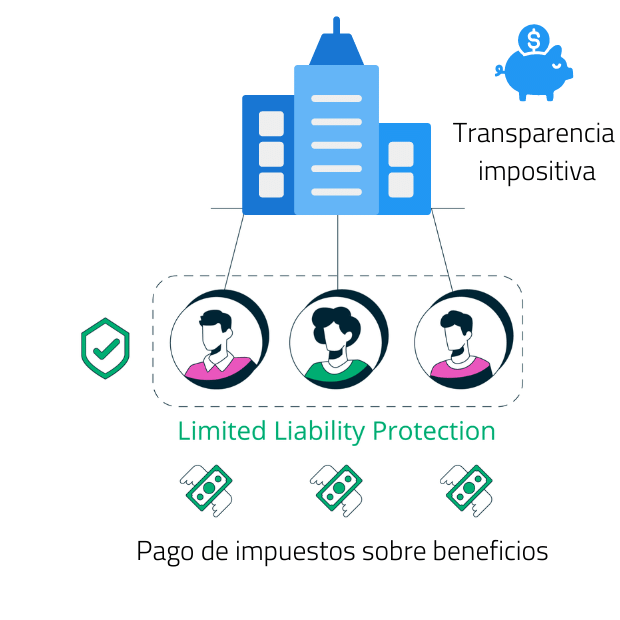
LLCs have pass-through taxation, which means the income they generate isn't taxed directly at the business level; instead, each member must report and pay taxes personally on the profits earned.
If you're a non-resident, your LLC's tax burden may be affected by its classification as ETBUS (Engaged in Trade or Business in the U.S.), which could create additional tax obligations in the United States.
It's essential to carefully plan your LLC's taxation, since taxes can vary depending on the type of activity you carry out, such as sales of physical products in the U.S., trading, FBA, dropshipping, among others. Having the right tax strategy will help you optimize costs and comply with current regulations.
Meet your obligations
Once your LLC is up and running, it's important to meet your tax and legal obligations in both the US and Argentina.
In the US:
File annual reports (if required by the state).
Pay the LLC renewal fees.
Forms a non-resident Argentine must file:
Form 5472 + Pro Forma 1120: mandatory for every foreign-owned single-member LLC, even with no income. $25,000 penalty for not filing it.
Form 1040-NR: if the LLC has Effectively Connected Income (ECI/ETBUS).
Form 1065 + Schedule K-1: if the LLC has more than one partner.
And what if your LLC had no income? You still have to file Form 5472. Not filing is a costly mistake.
In Argentina:
Argentina taxes worldwide income: your LLC's income must be reported in Argentina even if it's generated abroad.
Relevant taxes: Ganancias (income tax, under the general regime or monotributo, as applicable), Bienes Personales (personal assets tax; your interest in the LLC is a foreign asset that must be reported).
Information reporting regime for interests in foreign companies.
If the LLC is considered a CFC (a controlled entity without economic substance), ARCA may require taxes to be paid in advance.
There is no double taxation treaty between Argentina and the US. But Article 130 of the Income Tax Law lets you claim taxes actually paid abroad as a tax credit (explain with a simple example).
Consider hiring an accountant who specializes in international taxation to optimize your tax burden.
Although the US and Argentina don't have a treaty to avoid double taxation, you can deduct the taxes paid in the US from your tax return in Argentina.

How much does it cost to open and maintain an LLC?
Costs fall into two categories: setup (one-time payment) and maintenance (annual).
Setup costs:
State filing fee: between $50 (New Mexico) and $300 (Texas), depending on the state.
Registered agent (first year): between $50 and $150; many services include it in the package.
LLC formation service (if you use an intermediary): between $350 and $900, depending on the provider and the services included.
EIN application: free if done directly with the IRS; between $50 and $150 if outsourced.
Annual maintenance costs:
Registered agent renewal: between $50 and $200 per year.
State annual report: between $0 (New Mexico, Texas) and $300 (Delaware).
Tax filing: if you hire an accountant or specialized service, between $200 and $500 per year, depending on complexity.
Bookkeeping: variable; from $50/month for freelancers with few transactions.
In short, for a typical Argentine freelancer's LLC in Wyoming or New Mexico, the total first-year cost can range from $500 to $1,200, and annual maintenance from $200 to $600.
How to bring your LLC's dollars to Argentina?
We know this is a topic that worries Argentine entrepreneurs a lot. In fact, it's the reason many decide to open an LLC in the United States. Fortunately, there are several ways to bring your dollars to your home country:
Direct bank transfer (SWIFT): from your LLC's bank account to a dollar account in Argentina. Subject to current currency regulations and conversion to pesos at the official exchange rate.
Fintech platforms: Wise, Payoneer or similar services let you receive funds in the LLC and then send them to Argentina at more competitive exchange rates.
Crypto: Some entrepreneurs convert to USDT or another stablecoin and trade on local exchanges. It's an increasingly popular route, but it has tax implications that must be reported.
Many entrepreneurs choose to leave the funds in the US for investments, spend directly with the debit card from the LLC's bank account (Mercury, Relay), and only bring over what they need.
Whichever option you choose, you should know that any profit distribution or salary received from the LLC must be reported to ARCA in Argentina.

Common mistakes when opening an LLC from Argentina
Believing that if the LLC had no income you don't have to file with the IRS: Form 5472 is still mandatory, and the penalty is $25,000.
Not reporting the LLC to ARCA in Argentina. Your interest in a foreign entity must be reported for Bienes Personales and under the information regime for interests in foreign companies.
Choosing the wrong state: opening in Delaware "because everyone does" without considering that its annual report costs $300 and offers no real advantages for an individual freelancer.
Not having an Operating Agreement. Although it isn't always legally required, banks like Mercury ask for it to open the account.
Applying for the EIN with incorrect information: it can invalidate the number and cause problems with the IRS.
Mixing personal finances with the LLC's compromises the limited liability protection.
Not hiring an accountant with international tax experience: an Argentine accountant who doesn't know the IRS, or an American CPA who doesn't know ARCA, leaves blind spots.
Do I need to travel to the United States to open an LLC?
No, you don't need to travel. The entire process can be completed remotely with the help of a registered agent in the state where your LLC will be formed. This includes filing documents and obtaining the EIN.
What is the best state to open an LLC?
It depends on your needs. States like Delaware and Wyoming are popular for their low maintenance costs and tax flexibility. Florida is also an attractive option if you plan to operate there physically or are looking for local financial services.
How much does it cost and how long does it take to open an LLC?
The average cost to form an LLC ranges from $300 to $800, depending on the state and the additional services you hire. Processing time is usually 2 to 3 weeks, although some states offer expedited filing options.
Is it legal to open an LLC as an Argentine resident?
Yes, it's completely legal. You don't need to be a US citizen or live in the country. However, as an Argentine tax resident, you'll have to meet local tax obligations on the income you generate through the LLC.
What types of businesses are ideal for an LLC from Argentina?
An LLC is ideal for freelancers, service exporters, tech startups, and sellers on platforms like Amazon, eBay or Etsy. Its tax flexibility and ability to operate in dollars make it a convenient option for global businesses.
What if I want to open a bank account in the United States?
Although it isn't mandatory, opening a bank account makes managing your business finances easier. Some banks let you do it online, but in other cases you might need the help of specialized services or an in-person visit, depending on the bank and the state you choose.
What obligations must I meet after opening my LLC?
You must keep up with the state's annual renewals, maintain up-to-date accounting records, and file the required tax returns in both the United States and Argentina. It's also essential to renew your registered agent if you decide to switch providers.
Do the United States and Argentina have a treaty to avoid double taxation?
No, the United States and Argentina currently don't have a tax treaty to avoid double taxation. However, in 2022 both countries signed a Tax Information Exchange Agreement, which took effect on January 1, 2023. This agreement allows the automatic exchange of financial information between tax authorities, promoting transparency and fighting tax evasion. Although it doesn't eliminate double taxation, Argentine tax residents with income from a US LLC must meet their tax obligations in both countries. For greater clarity, it's advisable to consult a tax advisor who can help you manage these obligations correctly and optimize your tax burden.

Written by
Ignacio Navarro
Ignacio Navarro is a Certified Public Accountant, founder of Start Companies and a specialist in U.S. companies for entrepreneurs, freelancers and digital businesses in Latin America. With training in international taxation and studies at UCEMA, he advises non-resident clients on forming and maintaining LLCs, opening bank accounts, invoicing, accounting and taxes. His experience combines tax strategy, compliance and practical vision for operating in the U.S. in a simple, organized and professional way.


