
LLCs are a U.S. business structure recognized worldwide for the major advantages they offer: limited liability, anonymity, ease of formation and management, but above all, for the significant tax advantages they provide.
Have you heard that U.S. LLCs don't pay taxes? Well, it's true, as long as a series of conditions are met.
In this article, we'll teach you in 10 minutes everything you need to know about how LLCs are taxed in the United States. Let's get started!
How does LLC taxation work?
How an LLC is taxed depends on a series of factors specific to your situation. So let's start with the basics: in the USA there are 2 types of taxes, federal taxes and state taxes.
Federal taxes
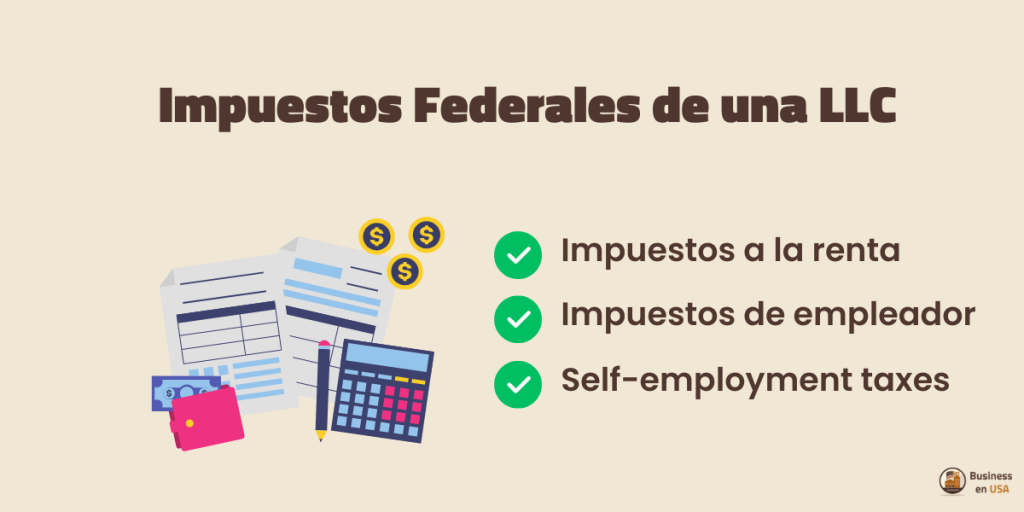
Federal taxes are the taxes collected by the U.S. IRS (Internal Revenue Service). There are several federal taxes:
Income tax
A Limited Liability Company (LLC) is considered by the IRS to be a pass-through entity. This means that LLCs themselves do not pay tax on their business income. Rather, it is their members who pay taxes on their share of the LLC's profits on their personal tax return, according to the rules of their country of residence.
So, if your LLC has no physical presence in the United States and you do not qualify as ETBUS, you will not be subject to U.S. federal income tax. By having no physical presence, we mean that:
- Your LLC has no members residing in the United States
- Your LLC has no dependent agents in the USA, that is, someone who lives in the USA and whose main source of income comes from your LLC.
- Your LLC has no physical presence in the United States (a warehouse, an office, a storefront, etc.)
What if I do have to pay income tax?
If you do not meet the conditions mentioned above, your business may have to pay tax on its profits in the United States. If that is the case, this table summarizes the taxable amounts:
| Rate | Profits | Total due |
|---|---|---|
| 10% | $0 to $9,950 | 10% |
| 12% | $9,951 to $40,525 | $995 plus 12% of the amount over $9,950 |
| 22% | $40,526 to $86,375 | $4,664 plus 22% of the amount over $40,525 |
| 24% | $86,376 to $164,925 | $14,751 plus 24% of the amount over $86,375 |
| 32% | $164,926 to $209,425 | $33,603 plus 32% of the amount over $164,925 |
| 35% | $209,426 to $523,600 | $47,843 plus 35% of the amount over $209,425 |
| 37% | $523,601 or more | $157,804.25 plus 37% of the amount over $523,600 |
Employer taxes
LLCs that have employees in the United States must withhold and pay payroll taxes. These include unemployment, Social Security and Medicare taxes.
If you have no employees, this tax does not concern you.
| Tax | Tax Rate | Who Pays |
|---|---|---|
| Unemployment Taxes | 0.6% on the first $7,000 in wages | Employer |
| Social Security Taxes | 12.4% on wages up to $132,900 | Employer and employee split the tax equally |
| Medicare Taxes | 2.9% on all wages, plus an additional 0.9% tax on wages over $200,000 | Employers and employees split the tax equally. Only employees pay the additional tax. |
Self-employment taxes
Individuals who are neither U.S. citizens nor U.S. residents are not subject to self-employment tax.
If you are a U.S. citizen or resident and own an LLC, you must pay self-employment tax on your percentage of ownership in the LLC. Self-employment tax consists of a 12.4% Social Security tax and a 2.9% Medicare tax. Half of this tax can be deducted as a business expense.
State taxes
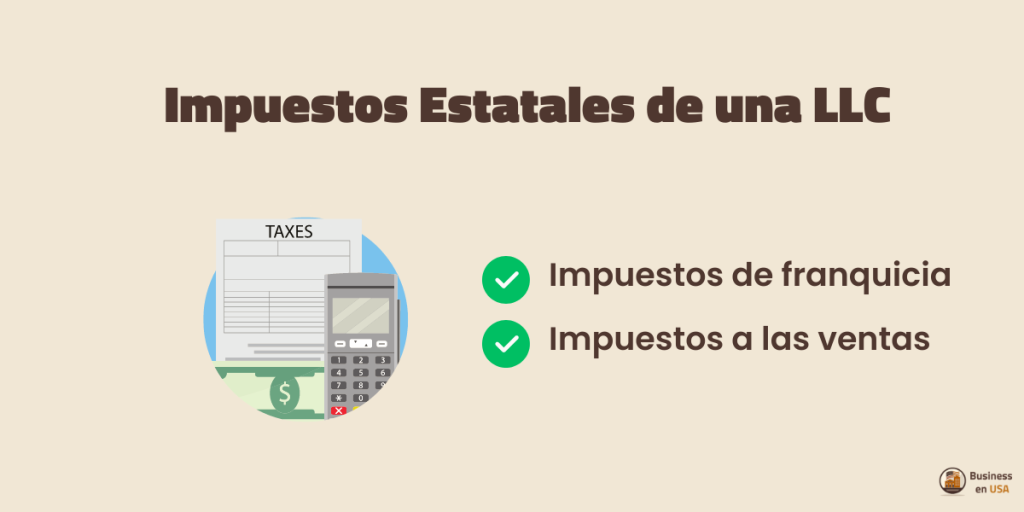
Each U.S. state has its own rules. As you might expect, in addition to federal taxes, an LLC may be subject to state taxes.
Franchise Tax
One of the most common state taxes is the franchise tax, which LLCs in certain states must pay every year. In states like Delaware, it amounts to $300/month. New Mexico LLCs do not have this tax.
Sales Taxes
If your LLC sells taxable goods or services, you may have to collect sales taxes from your customers and remit them to the state tax agency. Whether you have to pay this tax depends on the nexus you have with the state in question. Having a physical store in the area, employing people in the area or simply shipping goods to the area can be enough nexus to be required to collect Sales Taxes.
This tax is usually only collected when sales exceed a certain volume of transactions or revenue. In addition, there are 5 states that do not collect Sales Taxes: Oregon, New Hampshire, Delaware, Montana and Alaska.
Taxed as an LLC or as a Corporation?
Although single-member LLCs and multi-member LLCs operate as pass-through entities by default, LLCs also have the option to be taxed as:
- A C-corporation: C-corps pay tax as a company on their income (21%) and then distribute dividends to shareholders.
- An S-corporation: an S-corporation is also a pass-through entity, but there are a few differences in how salary and dividend distributions to members are taxed.
It is important to note that changing your LLC's tax status will not affect its legal status. If you choose to be taxed as a corporation, your business will continue to operate as an LLC.
In summary
- If you form an LLC as a Non-Resident, with no dependent agents and no physical presence in the USA, you will pay 0 federal taxes and no sales taxes, but you may have to pay a franchise tax, depending on the state you choose for your LLC.
- If you form an LLC as a U.S. resident, with employees or a physical presence, you may have to pay U.S. income tax, employer taxes, self-employment taxes, franchise tax and sales taxes.
How much tax does an LLC pay?
If you are a U.S. resident and your LLC is taxed as a “Partnership”, you will pay income tax ranging from 10% to 37%. If you are not a resident and have no physical presence or dependent agents in the USA, you will pay 0% tax in the USA. An LLC can also elect to be taxed as a C-Corp and pay corporate tax (21%), or as an S-Corp.
How does an LLC pay taxes?
An LLC's taxes can be paid to the IRS either by check or through its online platform. If the LLC does not elect to be treated as a C Corporation using Form 8832, it will not owe corporate taxes, and its profits will be taxed when they are included on its members' personal returns.
What happens if I forget to file my LLC's taxes?
Failing to file your income tax return with the IRS by the due date can result in a penalty of 5% of the unpaid taxes for each month of delay. The total penalty will not exceed 25% of your unpaid taxes. After 60 days of delay, the minimum penalty for not filing is $210. If the amount of tax you owe is less than that, the penalty will be 100% of your total tax.
What happens if I forget to pay my LLC's taxes?
If you file your LLC's return but don't pay the taxes on time, the IRS will charge you 0.5% of the unpaid taxes for each month of delay, up to a maximum of 25%. If you neither file the return nor pay taxes by the due date, the maximum charged per month for both penalties combined is 5%. In all cases, penalties are capped at 25% of the year's tax debt.
How much tax does an LLC pay for digital services?
In general, if the LLC is owned by a resident, has a physical presence, or has dependent agents, it may have to pay income tax, sales tax and other applicable state and local taxes. In addition, if the LLC has employees in the USA, it could also be subject to employer taxes. On the other hand, if your LLC is owned by a non-resident and provides services from abroad to clients outside the USA, it is very likely that it will not owe taxes. Many freelancers open LLCs to sell digital services this way.
How much tax does an LLC pay for Dropshipping or FBA?
Selling physical products on Amazon through FBA or dropshipping raises issues about classifying businesses as ETBUS, due to uncertainty over whether Amazon can be considered a Dependent Agent. This situation has created the need for a court ruling or IRS clarification. Currently, the interpretation most favorable to taxpayers is used, under which Amazon is not considered a Dependent Agent and the LLC's business activity is not considered ETBUS. However, it has been stated that the physical location of the goods at the time they are sold is the most important criterion for determining whether an eCommerce business must pay taxes.
How much tax does an LLC pay for Trading?
Gains and interest earned from trading stocks or securities are not considered ETBUS-sourced under Section 864(b)(2)(A) of the Internal Revenue Code, and therefore LLCs owned by non-residents have no U.S. tax obligations on that income. However, dividends are subject to a 30% income tax, although this withholding can be reduced if the LLC owner's country of tax residence has a Tax Treaty with the U.S. Learn more about LLCs for trading and investing.

Written by
Ignacio Navarro
Ignacio Navarro is a Certified Public Accountant, founder of Start Companies and a specialist in U.S. companies for entrepreneurs, freelancers and digital businesses in Latin America. With training in international taxation and studies at UCEMA, he advises non-resident clients on forming and maintaining LLCs, opening bank accounts, invoicing, accounting and taxes. His experience combines tax strategy, compliance and practical vision for operating in the U.S. in a simple, organized and professional way.