
Opening an LLC in the United States as a nonresident provides a number of attractive tax advantages.
Specifically, no taxes will be paid at the company level; instead, the owners must report the profits they receive from the LLC on their personal returns and pay taxes on them in their country of residence.
However, this is only possible if the company does not qualify as ETBUS. If the company is not ETBUS, even if it generates income in the United States, that income is not taxed in that country.
To clear up your doubts, below we explain exactly what this category means, how to tell whether your business falls into it and which taxes you will have to pay if it does. Let's get started!
What is ETBUS?
ETBUS (Engaged in Trade or Business in the US) is a term that refers to a company outside the USA engaged in business within the USA.
Basically, it is a concept used in the tax and corporate world, and it refers to companies that have a significant level of U.S. goods or users in their operations.
When it falls under the ETBUS classification, an LLC must pay state and federal taxes in the United States.
How do I know if my business is ETBUS?
A company may be considered ETBUS if:
- It has at least one "dependent agent" in the United States, meaning employees or companies that work almost exclusively for you, and
- This dependent agent allows you to carry out your activity in the United States,
- It carries out "considerable, continuous and regular" activity in the United States. The courts have not established a clear, precise standard of what constitutes "considerable, continuous and regular" activity.
- There are LLC members who are U.S. residents.
- You have permanent physical establishments in the United States
In addition, other circumstances can turn your business into an ETBUS. The tax code and court decisions are imprecise regarding the definition of ETBUS.
Book a free consultation about whether you are ETBUS
- U.S. business experts
- Legal and accounting team
- Free first consultation

IRS criteria for ETBUS status
The IRS uses these 3 criteria to determine whether or not a company is ETBUS.
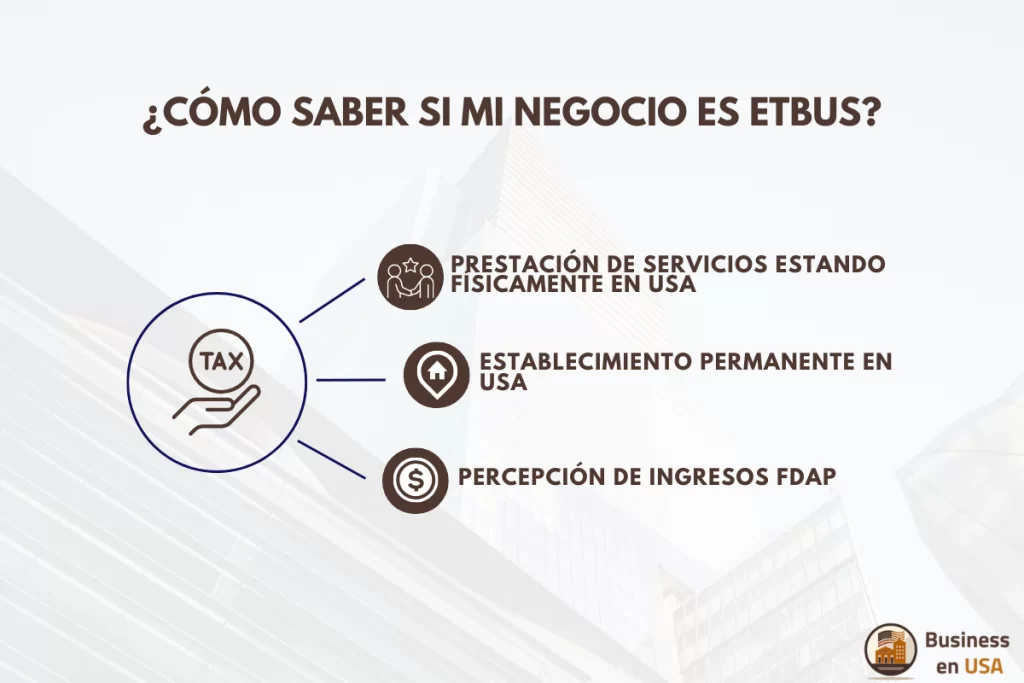
Providing services within the USA
First, your company will qualify as ETBUS if you perform any kind of work or offer any kind of service while you are physically in the United States.
According to the IRS's own rules, only compensation for work or personal services performed outside the country is considered income from non-U.S. sources.
Permanent establishment in the United States
On the other hand, if you have a permanent establishment in the United States, your business will also fall into the ETBUS category.
On this point, you should understand that the tax agency considers your company to have a permanent establishment if it has a fixed place of business that acts as a material factor in generating income or an agent or salesperson with authority to enter into contracts for the company within the country.
Receiving certain types of income
In turn, fixed, determinable, annual or periodic (FDAP) income is subject to state and federal taxes even if your LLC does not carry out activities within the country.
FDAP income includes:
- Rents
- Interest
- Dividends
- Wages
- Premiums
- Compensation
- Remuneration
- Annuities
Examples of ETBUS status
I understand these concepts can be confusing. Let's make things clearer with examples.
Example 1: Foreign software company with no office or representative in the United States
An Argentine software company develops products for U.S. clients. Its offices are in Argentina, and it has no offices or employees in the United States. The members are not U.S. residents or citizens. All sales are made through video calls.
In this case, the LLC's income is not subject to tax in the United States, since it does not qualify as ETBUS.
Example 2: Foreign software company with no office or representative in the United States
A foreign entrepreneur uses the "Fulfillment by Amazon" service to sell products in the U.S. market:
- The entrepreneur is not American and lives in Venezuela. He manages his business online
- The products are ordered and shipped to Amazon warehouses in the USA, where Amazon employees pack and ship the products to customers in the U.S.
- Amazon does not act as a dependent agent, since it has its own operations with millions of other customers.
- Even though Amazon is not a dependent agent, the seller could be considered ETBUS. If the seller does not manufacture the product and the transaction and transfer of ownership take place in the U.S., the company may have to pay income taxes in the U.S.
Since the ETBUS rules are a gray area, it's recommended that you consult a tax professional to confirm your situation.
What taxes would I have to pay if I am ETBUS?
If, unfortunately, your LLC qualifies as ETBUS, then you will have to pay several U.S. state taxes (which depend on each state) and federal taxes (paid at the national level to the IRS).
Federal income tax
This tax, one of the most important in the country, is paid to the IRS in proportion to your income. Below is a table with the details:
| Taxable Income | Tax Owed |
|---|---|
| Not over $11,000 | 10% of taxable income |
| $11,001 - $44,725 | $1,100 + 12% of the excess over $11,000 |
| $44,726 - $95,375 | $5,147 + 22% of the excess over $44,725 |
| $95,376 - $182,100 | $16,290 + 24% of the excess over $95,375 |
| $182,101 - $231,250 | $37,104 + 32% of the excess over $182,100 |
| $231,251 - $578,125 | $52,832 + 35% of the excess over $231,250 |
| Over $578,125 | $174,238 + 37% of the excess over $578,125 |
State income tax
State income tax, meanwhile, must be paid on your personal returns. However, only some LLCs pay this type of tax, depending on the state and their income.
For example, in California, limited liability companies that earn more than $250,000 a year must pay between $900 and $11,000.
Annual tax
As with state income tax, the annual tax is paid according to the state where your LLC is located. In this case, payment is mandatory, whether or not you generate income.
State sales tax
Another tax you will have to pay if your company qualifies as ETBUS is state sales tax, which applies when a product or service is sold and is paid to the state where the transaction took place.
Except for the five states that don't charge this tax (Alaska, Delaware, Montana, New Hampshire and Oregon), the rest have fairly high thresholds, generally over $100,000.
Payroll tax
If you have an employee who is a U.S. resident, or one or more LLC members who are residents of the country, you will have to pay payroll tax, which is 7.65%, made up of Social Security (6.2%) and Medicare (1.45%). The remaining 7.65% that makes up the total 15.3% must be paid by the employee.
Corporate tax
If you have a corporation instead of an LLC, you must also pay corporate income tax at the corporate level (21% of total taxable income). In addition, the amounts will also be taxed at the individual level (double taxation).
Excise tax
Last but not least, there are some excise taxes or consumption taxes, which are usually paid on fuel, heavy trucks, airline tickets and tobacco.
As you can see, if your LLC qualifies as ETBUS, you will have to pay quite a few taxes that can seriously affect your financial situation and that of your business, so it's essential to get good advice to make sure you don't fall into this category (if you can avoid it).
Book a free consultation about your LLC
- U.S. business experts
- Legal and accounting team
- Free first consultation
Get your questions answered now

Written by
Ignacio Navarro
Ignacio Navarro is a Certified Public Accountant, founder of Start Companies and a specialist in U.S. companies for entrepreneurs, freelancers and digital businesses in Latin America. With training in international taxation and studies at UCEMA, he advises non-resident clients on forming and maintaining LLCs, opening bank accounts, invoicing, accounting and taxes. His experience combines tax strategy, compliance and practical vision for operating in the U.S. in a simple, organized and professional way.