

If you are looking to start a company in the United States, a corporation may be the business structure you need. In this guide, we will look in detail at everything you need to know and do to open a corporation. So let's start with the basics!
What is a corporation?
A corporation is a business entity separate from its owners and shareholders. This type of business structure offers numerous advantages, most notably limited liability protection for its shareholders and the ease of transferring ownership.
In a corporation, the shareholders are the owners and they elect a board of directors to oversee its operations. The corporation operates under bylaws and guidelines set by its board of directors, which is also responsible for admitting or removing new companies and shareholders and distributing company shares, among other things.
The different types of corporations in the USA
There are 2 main types of corporations in the USA, each with its own features, advantages and disadvantages. More precisely, they are 2 possible tax structures that a corporation must adopt with the IRS.
C-Corps
C-Corp status is the default tax structure the IRS applies to corporations. The defining feature of a C-Corp is that it is subject to double taxation: first it pays corporate taxes, and then shareholders must pay personal taxes on the profits from dividends or the sale of shares.
The main advantage of being taxed as a C-Corp is that there are no restrictions on who can own shares and no limit on the total number of shareholders. This provides greater flexibility in the company's ownership structure.
S-Corps
S-Corp tax status means the company is not subject to double taxation. According to the IRS, these entities are considered pass-through, which means they do not pay corporate taxes and only the shareholders' income is taxed.
However, to qualify as an S-Corp, the IRS requires that the following criteria be met:
It cannot have more than 100 shareholders
It can only issue one class of stock
Ownership is limited to U.S. individuals, certain trusts and nonprofit organizations.
It must not be an ineligible corporation
It must be a domestic corporation
B-Corps
A B-Corp is a certification a company can receive to demonstrate its social responsibility and thus improve its reputation. B-Corps can be for-profit, but above all they must have a social mission. Contrary to what you might think, B-Corporations do not benefit from tax reductions: it is only an award, not a separate tax structure with the IRS.
Open your corporation in the USA in these 11 steps
Now that you are convinced that corporations, whether C-Corps or S-Corps, are the business structure you need, let's go step by step through how to open one.
1. Choose your corporation's name
The first thing you need to do to open a corporation is register its name. When choosing the name, in addition to thinking about marketing and branding, you must comply with certain legal formalities:
The corporation's name must contain an entity identifier, such as "Incorporated", "Corporation", "Company", "Inc", "Co" or "Ltd".
Avoid prohibited or restricted words, such as "trust", "bank", "credit union" or "trustee", or words related to a government agency, such as "FBI", "State Department" or "treasury".
We also recommend considering the availability of the domain name for your website and making sure there are no conflicts with other registered trademarks using the chosen name! You can check that here.
2. Register a DBA (optional)
If you want to do business under a name other than your corporation's name, you may need to register a DBA (Doing Business As) in your corporation's state of formation. The filing fee for a DBA ranges from 5 to 150 dollars, depending on the state.
To apply for a DBA, you will need to submit an online application through a state, county or local agency. This varies by state. If you will only use your corporation's official name for your business operations, you can skip this step.
3. Appoint the directors
When forming a corporation, the owners must appoint a board of directors. The owners can appoint themselves and/or other people as directors.
The directors' responsibilities include:
Directing the corporation.
Managing the corporation's business and affairs.
Electing the corporate officers.
Attending the mandatory corporate meetings.
The number of directors required varies by state. It can be a single director or three or more. It is also worth mentioning that directors can be changed once your corporation has been formed.
4. Hire a registered agent
A registered agent is a person or entity designated to receive legal documents and notices on behalf of a corporation. This agent acts as an intermediary between the corporation and state authorities.
The law requires every corporation to have a registered agent, but it also helps protect the privacy of its members. There are several companies that offer registered agent services, at an average cost of $200 per year, but members of the corporation can also serve as the agent if they meet the necessary requirements.
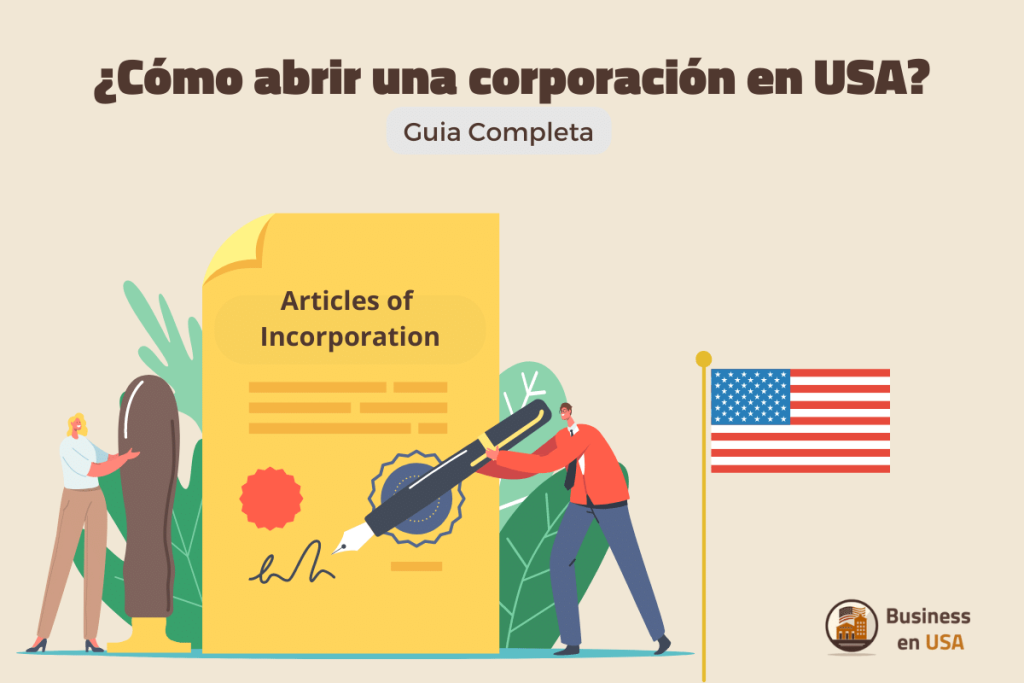
5. File the "Articles of Incorporation"
Next, you will need to file a legal document called the "Articles of Incorporation" with your state's Secretary of State office. Although the requirements can vary from state to state, they will generally include:
Your corporation's name.
Its principal place of business.
Its purpose.
The name and address of the registered agent who will accept legal documents on behalf of your corporation.
The names and addresses of the founders and/or initial members of the board of directors.
The Articles of Incorporation can usually be filed online on the Secretary of State's website. There you will find precise information on exactly what they must contain, since each state has different requirements, forms and filing fees.
Once the articles are approved (it usually takes about 2-3 weeks), you will receive a certificate of incorporation and your corporation will be established as an official business entity.
6. Draft the corporate bylaws
In some states, corporate bylaws are required to form the corporation. These bylaws are a set of rules and regulations that define how the corporation operates. The bylaws can be drafted before or after filing the Articles of Incorporation.
In general, corporate bylaws cover aspects such as:
The number of shares the corporation can issue
The number of directors required
How dividend distribution will work
Procedures for meetings and record keeping
etc...
It may be worth getting legal help to draft these bylaws. You can also find templates, but you must make sure they meet your state's specific requirements.
7. Draft a shareholder agreement (Optional)
A shareholder agreement is a legal document that sets out the rights, responsibilities and obligations of a corporation's shareholders if certain circumstances arise. For example, it will set procedures in case a shareholder dies, or how ownership transfers work.
It is an optional document, but one we recommend having.
8. Hold the first board of directors meeting
Once your corporation has been officially formed and the bylaws have been drafted, the first board of directors meeting must be held. At this meeting, the directors:
Appoint a permanent board of directors,
Approve the corporate bylaws
Set the corporation's fiscal year
Appoint the corporate officers, who are responsible for running the company's day-to-day operations
Authorize the issuance of shares.
Decide whether to operate as an S-Corp or a C-Corp
It is legally required to record and keep the minutes of all meetings of the board of directors.
9. Issue shares
After the board of directors has authorized the issuance of shares, it is time to issue shares to the shareholders.
When carrying out this issuance, it is essential to record the following information:
Identification of the share buyers.
Exact number of shares acquired by each shareholder.
Monetary value of the shares acquired.
Exact date the shares were acquired.
Most commonly, shares are issued as physical certificates or in digital format. Naturally, keeping an accurate record of all these transactions is essential to ensure transparency in the corporation's ownership, as well as the shareholders' rights.
10. Get an EIN
An EIN is a tax identification number used to identify the corporation for tax purposes, both at the federal level by the IRS and at the state level. You will also need it to open a bank account, hire employees, obtain licenses, etc...
You can apply for an EIN directly on the IRS website.
11. Apply for licenses and permits
Your business may need some kind of business license or permit to operate, but the requirements will depend on your corporation's state of registration and the activity you carry out. Some states require a general business license, and certain industries, such as CBD, firearms, medication or restaurants, will require additional licenses. Here you can find more information about this.
What to do after registering your corporation?
Once your U.S. corporation is registered, there are some important formalities to keep in mind when managing your company.
Open a bank account dedicated to your corporation
Once you have your corporation, it is essential to get a bank account tied to your business.
In addition to simplifying accounting and centralizing all of your corporation's transactions, this will allow you to protect your corporate veil and personal assets.
To open a bank account, you will need your EIN and your corporate documents.

Comply with the formalities required for corporations
There are certain formalities your corporation must comply with.
Keep the corporate bylaws up to date: Your corporate bylaws must be aligned with current laws and regulations. If you want to amend them, a vote must be held during a shareholders' meeting.
Set up a corporate record book: You must keep an official file where all of the corporation's important documents are recorded, including the bylaws, meeting minutes and stock records.
Hold the required annual meetings: Corporations are required to hold at least one shareholders' meeting and one board of directors meeting each year.
Give notice of meetings when required: A formal notice must be sent to all meeting participants (shareholders, directors, employees...). It must state the location, time and type of meeting.
Keep accurate meeting minutes: Many states require official minutes of meetings to be recorded. They must be accurate and detailed to provide a legal record of the corporation's decisions.
Comply with your state's laws, fees and taxes

Each state has different regulations, but in general, you may need to file annual reports and pay corporate fees to maintain your corporate status.
You will also need to file and pay corporate taxes on the company's profits with the IRS. Getting accounting and tax advice for this is highly recommended.
Finally, if you have U.S. employees, you will have to comply with a variety of employment laws and regulations.
Apply for Licenses
For certain types of businesses, you may need licenses from the state of New Mexico, your locality or even the federal government to operate legally. Find out here about the licenses required for your type of business (Alcoholic Beverages, Cannabis, Tobacco, Finance, Construction...).
Answers to your questions about registering a corporation
Should I open a corporation?
A corporation is a good fit for companies looking for:
Raising capital: Raising investment is simpler through corporations, since transferring ownership is fairly simple through the issuance of shares
Perpetual existence: Unlike LLCs, corporations can continue to exist regardless of changes in the organization's ownership
Tax benefits: In certain cases, being taxed as an S-Corp or a C-Corp can be advantageous.
In any case, it is important to make this decision correctly from the start, since although changing your legal structure later is possible, it is expensive.
What are the disadvantages of corporations?
Although the corporate structure can be very beneficial for certain businesses, there are some disadvantages:
An expensive and cumbersome formation process
Strict administrative formalities, such as annual meetings, meeting minutes, detailed financial reports…
It will be subject to double taxation, unless it is taxed as an S-Corp
Flexibility in managing the company is more limited than with an LLC or Sole Proprietorship
How much does it cost to register a corporation in the USA?
Forming a corporation in the U.S. involves several costs.
Filing the articles of incorporation: The cost varies depending on the state chosen, but it usually ranges from $100 to $250.
An advance payment of franchise tax: It usually ranges from 800 to 1.000 dollars. Not all states charge this tax.
Additional government fees of between $50 and $200 depending on the state of incorporation.
Other additional costs such as hiring a registered agent service (approximately $200 per year) and hiring lawyers may be necessary.
In which state should I open my corporation?
When choosing the state to incorporate your company, consider:
Incorporation costs
Franchise tax rates
The tax rate of the state you are considering for incorporation
the corporate laws of the state under consideration, in terms of the rights and responsibilities of shareholders, officers and directors, as well as creditors' rights in that state.
If you plan to do business mainly in a single state, it may be convenient to incorporate there.
Can a foreigner form a corporation in the U.S.??
Yes, it is possible. There are no U.S. federal or state laws that prohibit non-residents from forming a company in the United States. The U.S. market is open to everyone.
Should I open an LLC or a Corporation?
LLCs provide limited liability, are simpler to manage and maintain, and cheaper to form. In addition, an LLC can be taxed as an S-Corp or C-Corp without losing its LLC status.
However, dividing ownership is very complicated with an LLC, so raising investment will be very difficult.
Choosing between a corporation vs an LLC will depend on your current situation and your future goals.
Can a single person open a corporation?
Yes, if you are the sole shareholder, you can form a corporation in the United States. You will have to follow the same rules and administrative formalities as corporations with several shareholders.
If you still have questions, visit the IRS website or leave us a message!

Written by
Ignacio Navarro
Ignacio Navarro is a Certified Public Accountant, founder of Start Companies and a specialist in U.S. companies for entrepreneurs, freelancers and digital businesses in Latin America. With training in international taxation and studies at UCEMA, he advises non-resident clients on forming and maintaining LLCs, opening bank accounts, invoicing, accounting and taxes. His experience combines tax strategy, compliance and practical vision for operating in the U.S. in a simple, organized and professional way.