Corporations are extremely useful tools for building businesses anywhere in the world. That's because having a corporation as the legal structure for your business gives you numerous benefits, from legal to tax-related, as well as better access to financing.
That's why today we bring you a complete guide to corporations in the United States and how to form them. By following this guide, you will understand what a corporation is, what its advantages are and what you should keep in mind to know which type of corporation to form based on the nature of your business. Let's get started!
What is a corporation?
A corporation is a business entity separate from its owners and shareholders. In the United States, a corporation is a legal person, which means it has the same rights as an individual: it can own property, sell it, sue, be sued, sign contracts and even form new corporations.
A corporation is owned by its shareholders, who elect a board of directors to oversee the organization's activities. Corporations are therefore governed by their bylaws and their board of directors, which also govern the admission or removal of new companies and new shareholders, as well as the distribution of the company's shares and much more.
Finally, corporations can be for-profit or nonprofit, so they work both for businesses and for charitable organizations. Let's dig deeper into this!
The different types of corporations
There are several types of corporations, and you need to be very clear about the difference between each of them to understand which one is most suitable for your business. In other words, each has a different scale and approach to running a business, for both for-profit and nonprofit organizations.
In the United States there are at least 3 types: C-Corporations and S-Corporations, and we also have Nonprofit Corporations.
S-Corps
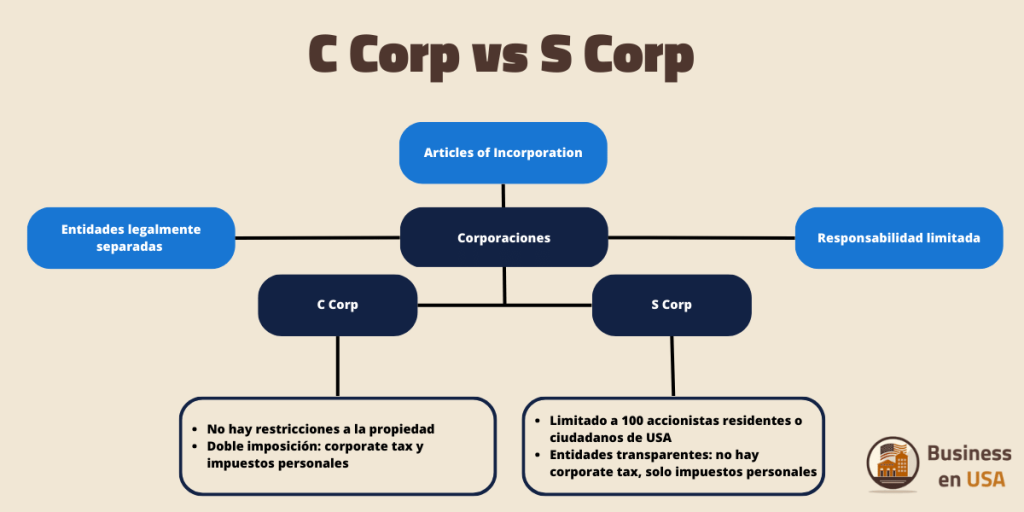
S-Corporations, or S corporations, are business entities that offer limited liability and "pass-through taxation", and are limited to 100 shareholders who must be US citizens or residents. Because of these features, they are popular with small and medium-sized businesses in the USA.
Like LLCs, S-Corps are transparent, or pass-through, entities: they pass income, losses, deductions or credits directly to the shareholders, without paying any federal tax. Shareholders report this activity on their personal tax returns, which allows S corporations to avoid double taxation on business income.
The biggest disadvantage of S-Corps is that they tend to be subject to scrutiny by the authorities because they have been associated with some tax collection irregularities in the past.
C-Corps
C corporations in the United States are very similar to S corporations:
They are for-profit, they are formed and governed by the same state corporate laws, they offer limited liability, and they observe the same internal formalities (board of directors, corporate bylaws, shareholder meetings, …).
The main differences from S-Corps are the following:
- C corporations have no ownership restrictions: there is no limit or conditions on shareholders, and they can issue different classes of stock.
- The way they pay taxes: A C-corp's profits are taxed at the corporate level when earned and at the shareholder level when distributed as dividends, which creates double taxation.
Nonprofit corporations
The structures of nonprofit corporations are actually quite similar to those of for-profit corporations; however, the people who fund them are not shareholders but donors, and like shareholders, they can influence the decisions the corporation makes.
However, nonprofit corporations do not generate profits, since their funds go toward some kind of public service or "altruistic" mission. Donations can come from a wide range of sources, including other corporations, and they are excellent tax deductions for those donors.
What are the advantages of corporations?
Clearly, there are many advantages that make forming a corporation attractive. It's no coincidence that they are the most widely used business structure in the world.
Limited liability
The first advantage has already been mentioned: corporations offer limited liability protection to their shareholders. They are not personally liable for the company's debts and obligations, so creditors cannot go after the owners' personal assets to pay the company's debts.

Easy transfer of ownership
Ownership of a corporation is usually easy to transfer through the issuance or sale of its shares (although S-Corps have certain limitations, as we saw earlier). Shares are bought and sold very easily on the stock market. This also allows corporations to raise funds easily, a luxury that most other business entities don't have.
For this same reason, corporations are usually the preferred structure for funding providers (banks, VCs, business angels...).
Corporate credibility
Having a well-known, highly reputable business structure, as corporations in the United States are, will give your business credibility. Potential investors, lenders, suppliers, customers and employees will know that your business is serious and built for the long term.

Tax advantages
Depending on how you have chosen to be taxed (S-Corp or C-Corp), the tax advantages will differ.
Although C corporations are subject to double taxation, S corporations are tax-transparent entities that have tax advantages, depending on how their income is distributed.
S corporations have the luxury of splitting their income between the company and the shareholders, which allows for some tax flexibility. Any income designated as the owner's salary will be subject to self-employment tax, while the rest of the company's dividends will be taxed on the personal tax return.
Perpetual existence
Corporations are technically immortal: unless they are dissolved by their board of directors or liquidated by the State, corporations can live forever, even after the death of all their investors. Technically, as long as money keeps flowing and income exceeds expenses, a corporation will stay alive.
What are the disadvantages of corporations?
Just as there are advantages, there are also a number of disadvantages to consider before forming a corporation. These are mainly related to regulations and the added responsibilities of being the owner or co-owner of an organization.
A tedious formation process and formalities
Opening and maintaining a corporation is not as simple as opening an LLC. Filing the articles of incorporation with the Secretary of State can be quick, but afterwards there is extensive paperwork to properly determine and document the details of the organization and its ownership, as well as to maintain it. For example, you need to draft and maintain the corporate bylaws, appoint a board of directors, create a shareholder agreement on changes of ownership, issue stock certificates, hold and record annual meetings, file regular reports, … We'll look at this in more detail below.
Double taxation
As we explained earlier, C corporations are subject to double taxation: first there is a tax on business profits, and then shareholders must pay personal taxes when they receive dividends.
How to open a corporation in the United States?
In the United States, a corporation can be formed in 9 steps. These are well described in the country's own laws and, although the steps may vary slightly depending on the State, the process is generally the same nationwide. Below, we describe the steps:
1. Choose a name for your corporation
Choosing your corporation's name is the first step for your business. It's not only important to consider marketing and brand credibility, but also to comply with certain legal requirements:
- You must add an entity designator, meaning that after the business name you must add the abbreviation Inc, Co, Ltd, etc., which stand for Incorporated, Company and Limited.
- You cannot use the names of public agencies or government entities, or words such as Bank, Trust, Trustee or Credit Union.
2. Appoint the directors
US regulators require that, when forming a corporation, the company's directors be appointed immediately. The directors are responsible for managing the corporation and electing the company's officers.
It's important to note that the owners can appoint themselves as directors or appoint other people, and that this board of directors can change later on.
3. File the Articles of Incorporation
To form a new corporation, you must file the Articles of Incorporation with the Secretary of State of the state where you decide to register your corporation. This can usually be done 100% online on that state's website.
This legal document sets out all of the company's details: its name, principal place of business, purpose, the address of the registered agent and the names and addresses of the incorporators, as well as the initial board of directors.
4. Draft the corporate bylaws
A corporation's bylaws are the rules and regulations that govern how it operates. These bylaws usually include:
- The duties assigned to each officer
- How business decisions will be made
- Where and when annual shareholder meetings will be held
- How and when shares will be issued
- The percentage of shareholders needed to make decisions
- Where and when dividends are paid
5. Hold the first board of directors meeting
Once the corporation is formed and the bylaws are drafted, the first formality must be completed: an initial directors' meeting. This meeting usually covers:
- Adopting the corporate bylaws
- Officially appointing the corporation's officers
- Obtaining authorization to issue shares
- Electing to be taxed as a C-Corp or an S-Corp
6. Issue shares
A corporation is owned by its shareholders, who contribute capital in exchange for shares. A share therefore represents a unit of ownership in the corporation.
Your corporation must execute the stock certificates and update the corporation's stock ledger, which tracks who owns shares and how many they own. Corporations are required to keep a record of how many shares they have issued, who owns them and how many are outstanding.
7. Draft a Shareholder's Agreement
The Shareholder's Agreement is an agreement among the shareholders that sets out how shares are issued and transferred. Its goal is to ensure that shareholders are treated fairly and that their rights are protected. It is optional, but it is highly advisable to have one to avoid any kind of disagreement in the future.
For example, this agreement determines how ownership will be handled if a shareholder dies, retires, becomes incapacitated or leaves the company. It also allows shareholders to decide which outside parties can become future shareholders and provides safeguards for minority positions.
8. Obtain an employer identification number
The EIN is a unique identifier assigned to a company so that it can be easily identified by the Internal Revenue Service (IRS). It is also required to open a business bank account, hire employees and much more. You can get an EIN quickly and free of charge on the IRS website.
9. Obtain business permits, licenses and a DBA
Most businesses need some kind of business license or permit to operate, but the requirements will depend on the state where you registered your corporation and on your industry. The firearms, tobacco or alcohol industries, for example, usually need additional licenses to operate. You can check your state's specific requirements here.
Also, if you plan to do business under a name other than the corporation's official name, you will also need to register a DBA.
What if I need to dissolve my corporation in the future?
Dissolving a corporation also involves a series of steps you must follow, which ultimately wind up the company, leaving everything in order and compensating those affected by its closure. These are the main stages to follow:
- Call a board meeting to formally propose the dissolution of the corporation. A vote must be held and the minutes of the meeting must be recorded and kept.
- File a certificate of dissolution with the Secretary of State. The paperwork can be filed online.
- Notify the IRS of your intention to dissolve the company. Pay all taxes owed, both to the state and to the federal government, in order to obtain a "consent to dissolve" or a "tax clearance".
- Close everything else: Close all bank accounts, lines of credit and service accounts held in the name of your corporation or company. Notify all your customers, suppliers and employees of your corporation's dissolution. Close your EIN
- Keep a record of everything, to prove that you have closed and left everything in order, in case it ever becomes necessary.
Conclusion
The business world in the United States is quite dynamic, and one of the best ways to enter it today, especially if you want your business to grow, is with a corporation. Although they are legal entities with quite a few formalities, they are the best solution when you want a large business whose ownership is distributed through the issuance of shares.

Written by
Ignacio Navarro
Ignacio Navarro is a Certified Public Accountant, founder of Start Companies and a specialist in U.S. companies for entrepreneurs, freelancers and digital businesses in Latin America. With training in international taxation and studies at UCEMA, he advises non-resident clients on forming and maintaining LLCs, opening bank accounts, invoicing, accounting and taxes. His experience combines tax strategy, compliance and practical vision for operating in the U.S. in a simple, organized and professional way.